
Abstract
The old cites suffer from weak sanitation networks, while other cities suffer from an expensive wastewater pumping system; this treatents the safety of water supply. And the spead of slaughterhouses in urban area leads to healthy and environmental problems and treatents the safety of ecological system. This study focuses on urban and regional planning for efficiency and sustainability for a healthy and smart urban space in Ouzera City. A one health and urban metabolism approaches are developed to achieve urban sustainability. The water and food security are also addressed by adopting one health approach for effective and sustainable planning across Ouzera region. And within the framework of the one health approach in the urban space this study examines Ouzera town where urban infrastructure planning is underway for a new sustainable urban pole that achieves the one health initiative. Two approaches are being considered; one primarily involves environmental planning based on two wastewater treatment units within the smart city and the protection of water resources on the surroundings areas. The scientific space based on the one health approach includes planning of a logistics area for animal and food health to be a complementary space to the faculty of veterinary sciences, away from the urban space of healthy and smart city. The one health approach is being used to plan the construction of dam with an advanced system that achieves water security by relying on the waters of the Atlas Mountains for urban sustainability and secure water supply in the smart city of Ouzera and the region of center. The center of research on one health integrates smart scientific facilities in Ouzera city and is integrated with the directorate of smart city within the second and third generation facilities of scientific and healthy smart city. The fourth generation of smart cities is approached by relying on sustainable economy of Ouzera region based on water, agriculture and the production of natural perfumes for operation and maintain scientific and healthy smart city of Ouzera.
Keywords
Urban metabolism One health Vital planning Smart city Water security. Food security sustainable economy
1.Introduction
Through the one health approach ,maintaining the integrity of ecosystem is fundamental to providing clean water and healthy food for both humans and animals.
And sustainable planning that focuses on food and agricultural activities that avoid environmental risks is essential for building a healthy and sustainable urban system.
Based on one health approach and within the urban context of Ouzera town and the region of center , water security and food safety are being planned .
How is this achieved through the one health initiative and urban metabolism approach.?
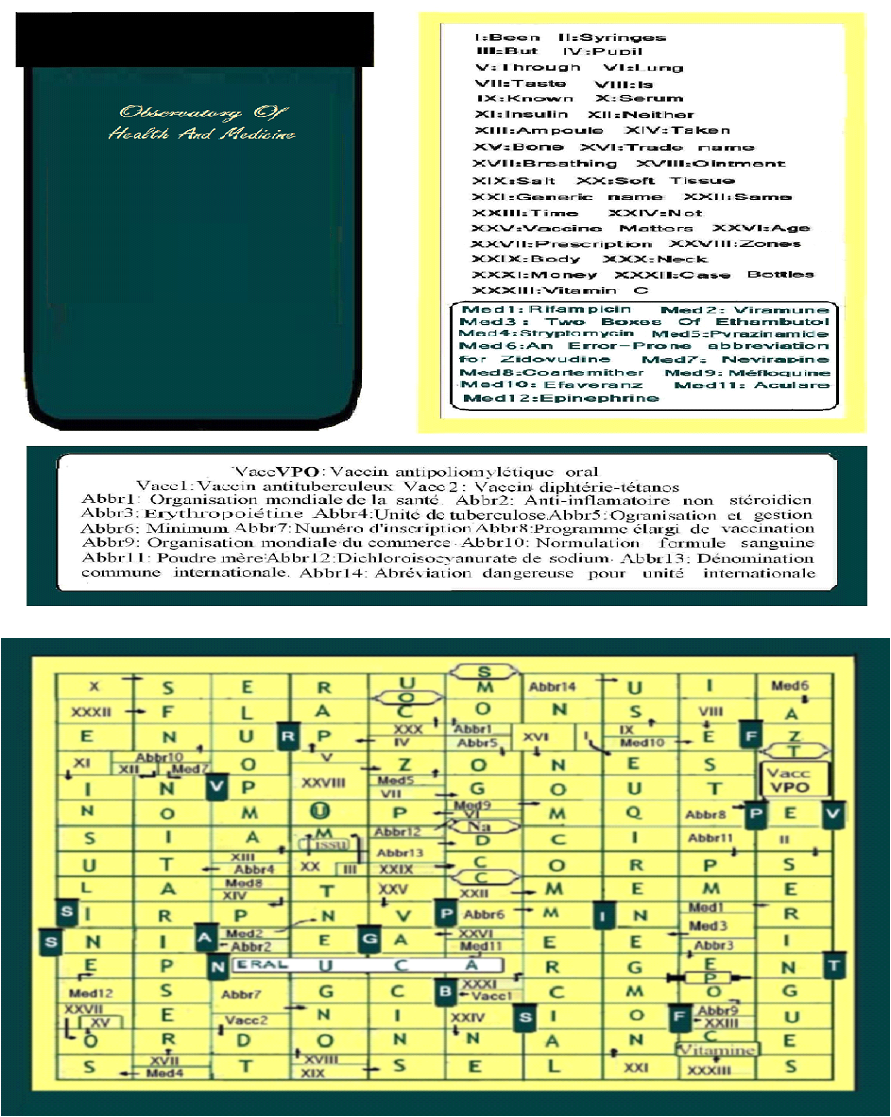
2.Scientific observatory of health and medicine in Ouzera.
Within the framework of the one health approach in Ouzera territory the joint structure for public and hygiene in Ouzera town contributes to preventing the risks of food poisoning and strengthening oversight of commercial activities and educational institutions through field visits to various educational institutions , restaurants , food shops, cafeteria , bakeries and butcher shops across the region..
Regarding animal health , animals are vaccinated against diseases by veterinarians , and epidemic diseases are prevented .
Doctors in the town contributes to treating diseases and linking their spread within the green environment .In the fields of health and medicine, we present a scientific observatory from Ouzera town that modeling the medical practices and includes data on human medicines with the understanding of specialists.
The observatory model provides medicines terminology and prescriptions in the language commonly used in medical circles and also offers scientific readings in English as a simplified model for understanding medical prescriptions .
It is preferable to write prescription through informatics to avoid misinterpreting abbreviations
3.Healthy urban planning and promoting vital and resilient planningforOuzera city.
The effective and resilient strategy of planning Ouzera city is based on the concepts ofbiomimetics and vital transportation , and planning with the concepts of urban metabolism and biophilic design ensures a healthy space based on the one health approach
3.1.healthy and vital urban planning for building a new integrated urban pole
The roads and various networks in the new green pole in Ouzera are planned according to the principle of urban metabolism and the vital and resilient transportation approach guides the planning of residential areas and the zone of industrial activities.
A dedicated area is allocated for the urban center with its vital infrastructure , and a n integrated area is designated for industrial activities, all within the framework of one health approach.
The main entrance to the integrated urban pole is directly from the north south motorway via a one way road. The motorway can be modeled as aorta and the road to the integrated urban pole is modeled such as one way valve on efferent vein.
This vital road follows the railway line to reach a vital main intersection in the new urban pole and continues its course towards the industrial activities area.
The route ensures resilient mobility for the integrated pole with urban vitality and regional appeal for the zone of activities which includes the following activities : Milk collection , cheese making , natural honey production , Jam and dried fruit production, olive oil press.
Regarding the truck parking currently located in Ouzera town .it is being addressed within the framework of the completed plans for developing a healthy city.
A designated parking area is being allocated in the east area suburbs , away from the urban environment to avoid noise pollution , the area is surrounded by vegetation and is accessible from the simple lane road via the motorway from the east of Ouzera city. The façade of this park is a building of craft in the shape of oak leaf.
The integrated green pole is planned within the framework of one health to ensure a healthy environment. The healthy and iconic design is based on biomimetics and biophilic design where iconic architectural façades give the pole a distinctive shape .
The resilient and efficient urban system is formed through biomimicry and urban mobility engineering with a sustainable vision.
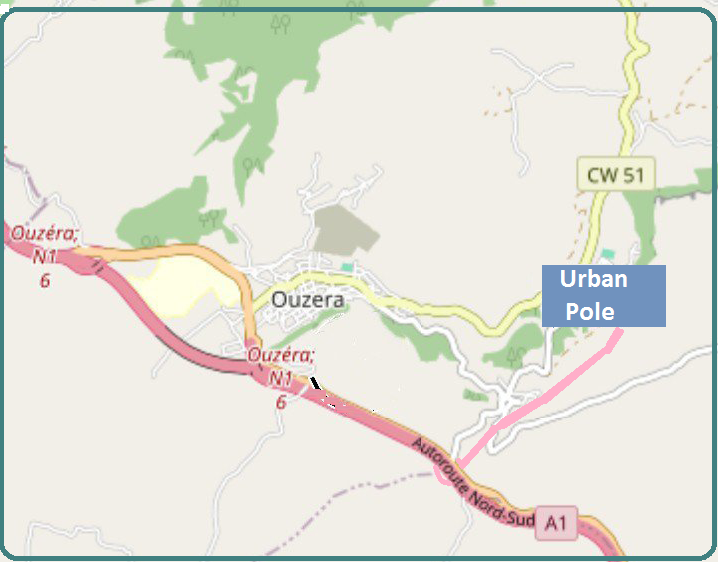
The planning through urban metabolism can address the fragile housing in the eastern suburbs of Ouzera town as an urban fabric that needs cellular vitality , as it is included within the expanded plan of the new urban pole. And within the framework of one health and urban metabolism the sewage network for the new urban pole is planned along with the suburb network and the route of the old railway line is relied upon as the main axis through which the main sewage channel passes , heading towards the treatment plant on the northern side of the city center.
The concept of urban metabolism , which aims to revitalize urban areas , involves relocating residents from fragile , dilapidated housing to a new urban fabric designed within a vital and sustainable green environment in Ouzera city. This transforms the damages urban area into an urban lung providing green spaces and emergency resilient reservoirs to enhance the resilient smart city.
The urban fringe of the secondary urban center of Ouzera as smart city becomes integrated with the area of industrial activities specializing in the food processing industry , forming an urban hub of food.
3.2. Healthy urban planning for the pole of science and health
The healthy environment in the pole of science and health with smart interface is planned by applying the one health approach and the approach of urban metabolism , as the area designed with the biophilic design approach based on green plants and water is protected from source of pollution and stray animals .
The area of train station and the rest area is considered a contact zone with the ecological and agricultural area .
A healthy environment is ensured by the one health approach with smart biobars on smart environmental monitoring points that use cameras to monitor the movements of animals coming to the urban area and handed over to farmers as guard dogs . regarding the water source that feeds the mains reservoir in Ouzera town , which its turn feeds several springs in the urban area, its underground sources are protected by directing the sewage network away from the ground water to cross the motorway through a special tunnel and end at a treatment plant instead of pumping it toward the north of town.
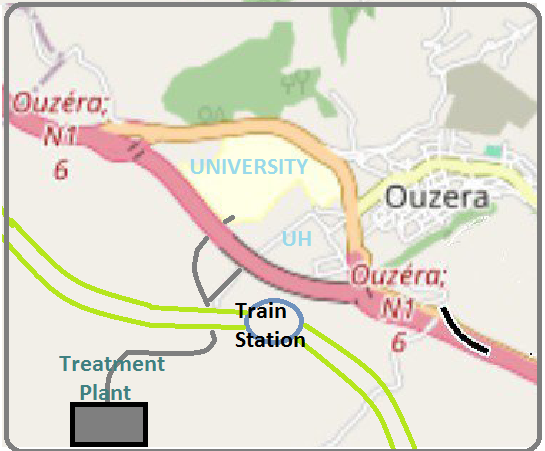
The .urban metabolism approach is also being planned for purification network at the university hospital specializing in mini invasive surgery with an integrated sewage system
The Energy flows represented by electicity andgaz are redrawn in the pole of health within the designed road network , and existing spaces that originally belong to the state are feed up prioritizing public benefit over private, thus ensuring sustainable and healthy urban space within the framework of urban metabolism and one health approach in the shape of biomimetic and biophilic urban space.
3.3. Biomimetics for enhancing resilient mobility in the urban pole of heal
To enhance resilience in accessing to the university hospital specializing in miniinvasive surgery from the motorway. The sino artirial node model is adopted as a biomimetic model to simulate traffic flow, where thenode acts as an auto pulse trigger that ensures resilient flow towards the pole of health .
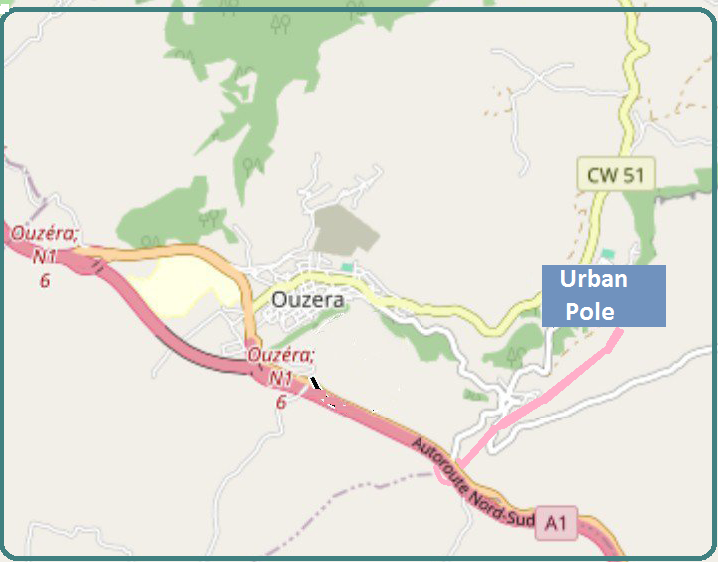
This model focuses on the eastern and western entrances to Ouzeracity and the main road while also incorporation a roundabout at the road leading to the university residences.
This route is considered more resilient as it ensures access to the health hub located to the north and south , without passing through the main interchange and offers a 1 Km extension on the motorway. These direct access point that connect the motorway to the health hub via the vital road and with the presence of the circular pivot point that connects roads leading directly to the sites of health and respond to traffic needs in emergency situations when the pulse increases and a sudden congetion occurs at the main interchange.
4.Regional planning for the logistic zone for animal and food health through one health approach.
The comprehensive planning of the logistic zone for animal health and food relies on a systematic approach that links economic and social capabilities within the geographical and urban area, and focuses on providing healthy food through one health approach within the local strategic plan. The establishment of the logistics zone for animal health and food is planned to achieve a balance between logistical efficiency , biosecurity , protection of ecological diversity and the agricultural sector.
4.1. The plan of the site
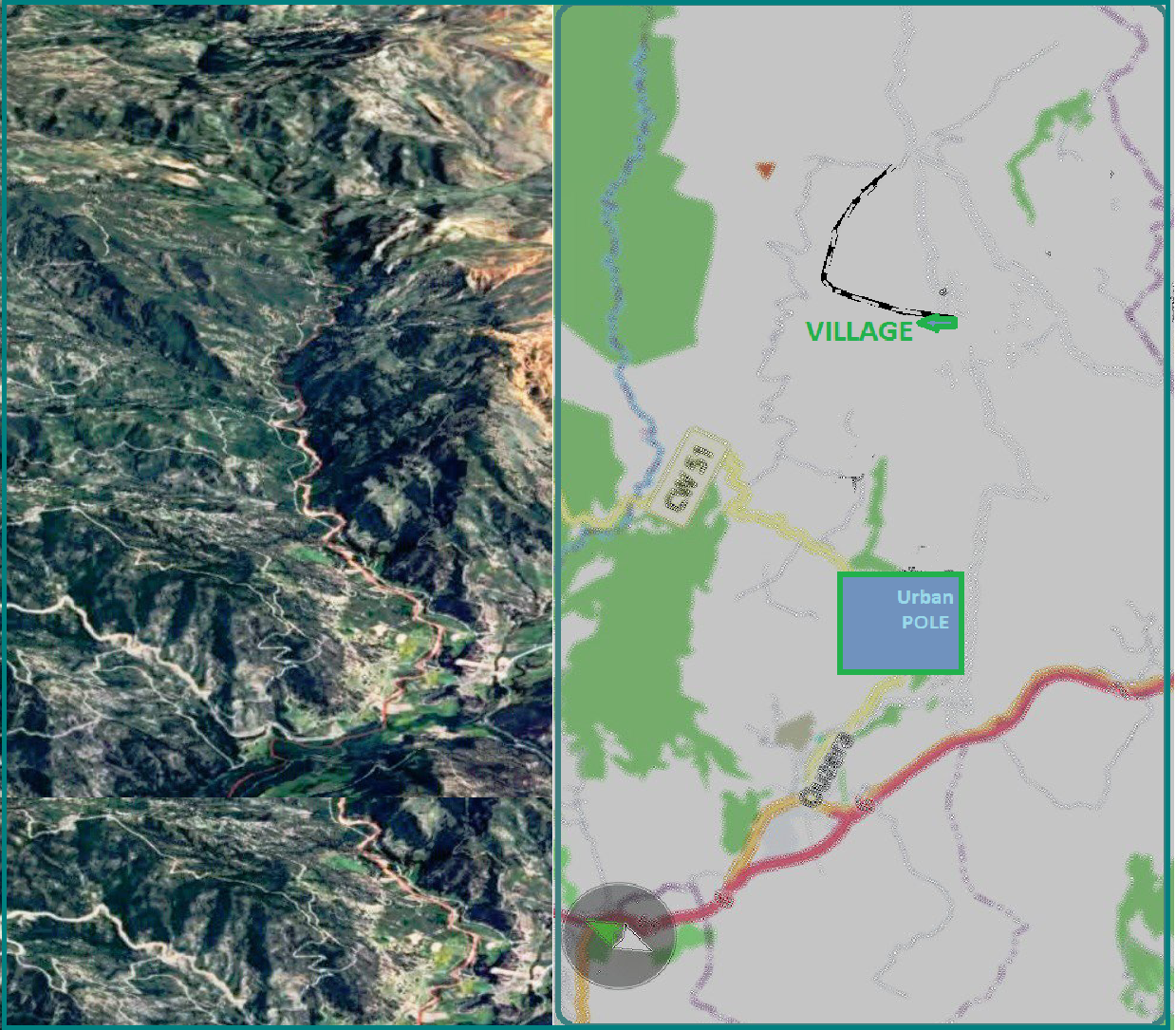
The planned area is located within the lands of state on the border between the regions of Ouzera and Médéa , in a steppe area on the southern side of the urban areas. This area is close to the road linking the interchange of Ouzera and the southern bypass of Médéa. And the logistic zone is siyuated away from the railway line within an ecological protected area.
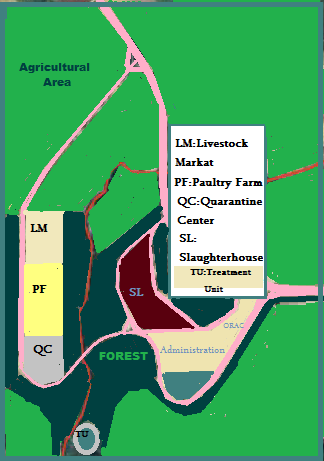
The clean and polluted areas are separed across two opposing plateaus , and strict preventive measures are planned to ensure effective biological separation and prevent the transfert of pollutant b between opposing plateaus. The plan implemented according to the one health approach is based on the principle of physical and functional separation between high risk operations and those requiring bio sensitivity
-
Western area
The breeding and live trading area represents the beginning of the chain , and the plan achieves the highest levels of biosecurity as the plateau located in the wind direction is designated for the livestock market , brooder and poultry farms and livestock quarantine center.
-
Eastern area
The processing and control area includes the end of the chain, where final products and waste are handled under the supervision of control center.
This plateau includes the slaughterhouse , the control center , and the administration area it is located on the windward side to prevent the transfer of odors and microbes to the western plateau , the waste treatment unit is located at the lowest point near the valley
-
Buffer zone
The agricultural area is protected by following water collection basin to prevent pollutants from reaching it . A 500 meter wide protection zone is established between the two plateaus and around the two areas. cypress and eucalyptus trees are used to reduce dust and airborne germs.
-
Drainage system and monitoring sensors
The drainage system is closed to isolate slaughterhouse water and waste from the natural water network on the slope, with the construction of biological treatment basing before the water reaches the surrounding lands.
The construction of agricultural terraces to filter the soil , and the placement of bio filters to absorb gases in the area of treatment.
The air quality sensors are placed on the area of the end of the chain to address environmental challenges and to achieve the one health initiative.
4.2. The resilient and safe network road
The plan of network road in logistics zone for animal health and food ensures smooth traffic flow and maintains biosecurity to prevent cross contamination .
The planning will adopt an environmentally friendly engineering approach, separating routes to ensure that clean lines transporting food do not intersect with dirty lines transporting live animals and waste.
Preventive landscaping with green belts is implemented between areas , and access roads to the administration are protected by dedicated entrances to minimize airborne transmission of pathogens routes in the western area are distributed with a dedicated ,wide road for the livestock market and poultry farms designed for large trucks and equipped with inspection platforms at the entrances .
While the road of quarantine center is closed and isolated, trucks are not allowed to pass through the market area.
There is also a one way road between the two plateaus to prevent contaminate trucks from returning to clean areas.
A clean route is designed on the eastern side for transporting healthy animals to the slaughterhouse , and an administrative route is also designed for the passage of health and veterinary control staff.
The roads are equipped with thermal cameras to monitor the animals’ temperature. During transport before they enter the eastern zone.
The space between the two plateaus is also used to install wind turbines or solar panels to power streetlights, entrances and refrigeration units in the slaughterhouse.
The Regional Poultry Farming Office of the Centre in actual abréviation ORAC is located in the face of principal road in the eastern entrance of logistic zone.
4.3.planning the agricultural areas of territory through one health approach
The logistics zone of animal health and food is located at covered area with sufficient distance from the road connecting the Ouzera interchange and the bypass of Médéa to ensure that traffic flow is not affected by occasional odors.
A designated area is provided for large trucks to facilitate smooth access to the logistics zone.
The regional slaughterhouse is surrounded by a perimeter wall with vents allowing for low pressure air flow ; and windbreaks prevents the transfer of contaminated dust or insects to agricultural lands.
The aromatic plants climbing the wall surrounding the slaughterhouse act as natural filters , altering the odor of the passing air .Extensive areas up 200 hectares are planted with olive trees in the fallow land between the logistics zone of animal health and food and the smart interface of Ouzera as healthy city.
These planted areas support air filtration by increasing the amount of forested land and also contribute to the efficient operation of a medium sized press of olive oil.
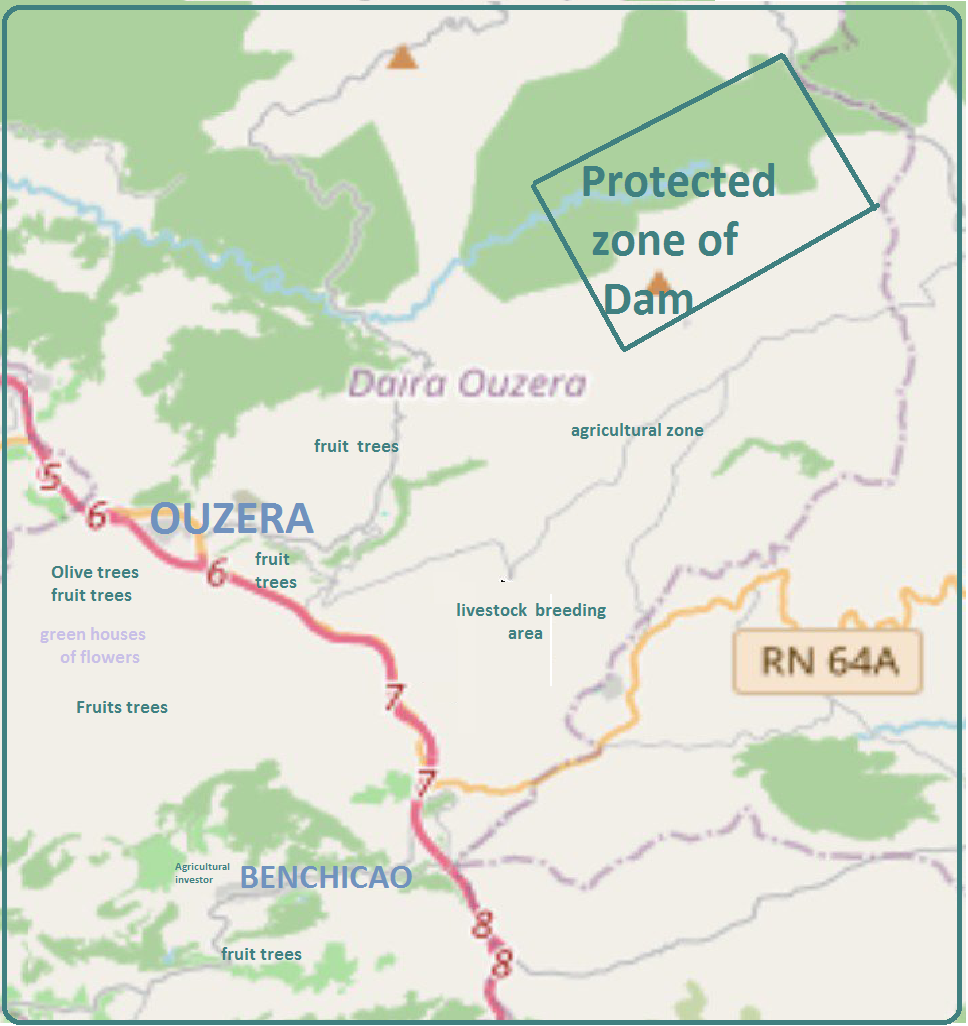
The fallow lands in the highlands between the forested areas in the mountains opposite the smart façade of Ouzera City are used to produce flowers inside greenhouses. Thus these farms provide protection for the forest cover from fires and contributes to the production of perfumes that fund the smart city for operation and maintenance.
The southern area of Ouzera territory is designated for livestock and cattle to ensure a continuous supply to dairy unit.
This area is a model of sustainable practices located far from the area designated for flower cultivation and beekeeping within the protected zone of dam in the northeast area of territory.
The land planted with fruit trees in the eastern area is preserved to support the operation of the dairy processing plant. The food processing zone extends its activities to neighboring regions.
This strategic vision embodies the one health approach and biosecurity by safe guarding human and animal health and protecting the environment across the region
5.The feasability of building a Dam in Ouzera region.
The Oued of Ouzera and its source in the tell Atlas mountain range , far from urban centers is considered a pivotal geographical site for the construction of dam that will enhance water security in the central region of Algeria.
The construction of this dam in Ouzera region is not just a hydraulic engineering project but a strategic investment in a project whose implementation relies on a hybrid approach that combines a precise initial analysis of the topography to ensure the safety of the structure and the integration of the one health initiative within the dam, protection system.
This approach ensures the sustainability of the dam and guaranties a balance between the health of the population and livestock and the sustainability of the surrounding ecosystem and agricultural areas, thus ensuring environmental sustainability and economic well-being for the region.
5.1.Site and terrain analysis
The valley of Ouzera appears on maps of valleys in Algeria as a primary source of the Atlas Mountains , which are characterized by significant snowfall, and its course extends to the sea
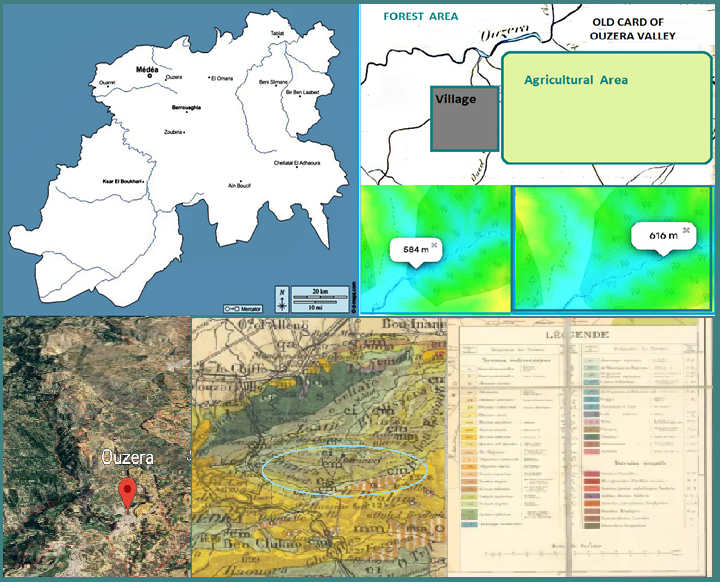
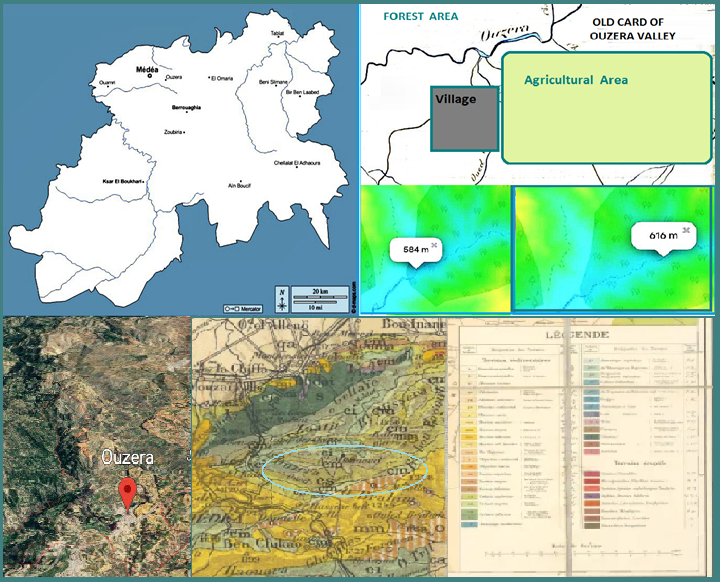
To construct a dam at the source of the Ouzera Valley, we analyze the topographical characteristics of the area and conduct a preliminary geography analysis based on existing maps according to the online topographic map, the dam site is characterized by rugged mountain on a terrain belonging to the tell Atlas Mountains range.
Elevations along the suitable dam construction area range from 584 meters above sea level representing a point where two mountains converge in the valley where the dam wall will be built. To 616 meters as the highest point on the eastern side .This point is approximately two kilometers from the dam wall construction line.
The wall can reach a height of 55 meters at highest points extending for 2.5 kilometers with a capacity of approximately 80 millions cubic meters and a branching width of up to 700 meters.
The dam is protected from flood on the eastern side by the dam of irrigation with a capacity of up to 25 millions cubic meters , located in the valley of southern course.
A protection system is used on the northern side where the valley originally from the mountains and the protection is provided by an irrigation dam with a capacity of 9 millions cubic meters, beginning the total capacity of the dam system to 114 million cubic meters. And based on the old geological map of Algeria , we can distinguish from a rough reading of the geological formations of the site shown in the figure 8 that the northern and southern mountains surrounding Ouzera valley have distinct formations Cretaceous formations appear in the area where the source of the valley is located , opposite them are Jurassic formations and Miocene formations extend to the south where the course of continues southwards .
These heterogeneous geological formations and the locations of site within a seismic zone necessitate in pepth geological studies to assure soil resistance and permeability at the valley site in order to select a suitable dam structure designed according to tectonic studies of the faults and approved standards.
5.2.The technical aspects of dam structure and its potential for generating electricity
The construction of dam in the valley of Ouzera relies a precise engineering that is compatible with a hydraulic system.
Rainfall rates in Ouzera region range between 400 and 600 mm in year with server drought in summer .
The capacity of storage is designed at 80 million cubic meters on the main basin , taking into account the nature of soil in the site of dam and the design flood that occurs with sudden rainfall in the northern region of Algeria over a 250 year period.
The year 2026 is considered a benchmark year during which several northern dams in Algeria are expected be full.
Roller Compacted concrete is chosen for the construction of Gravity Dam due to the heterogeneous geographical formations , this technology allows for the rapid construction of the Dam wall.
An advanced techniques are used to treat the gullies of dam particularly on the southern side , which is also protected by reservoirs in the gully and ravine formed within Miocene formation.
The dam is further protected from sudden rainfall and flooding by a special channel on the southern side.
The dam is equipped with a hydroelectric power station incorporating modern production technologies of electricity with high efficiency digital control system making sustainable production of energy.
5.3. Applaying one health approach in the dam protection system
Regarding the environment , the dam is protected from chemical leaks resulting from pesticides and fertilizers. As their use is prohibited in the agricultural areas adjacent to the dam , and the use of organic fertilizers is adopted .
The dam will be protected by three protection zones that rely on afforestation for protection, buffer zones and prevention of overgrazing.
-
The primary zone of protection :
The width of the areas ranges from 50 to 100 meters along the dam on both the northern and southern sides.
In this area adjacent to the dam , the natural vegetation cover is preserved to act as a natural filter with the addition of forest plants that act as an additional filter for the water coming from the reefs especially the southern ones that flow into the dam and act as natural filters that prevent soil erosion.
-
The second protection area: extends 400 meters from the end of the first area on both sides of the dam .
This area is dedicated to the cultivation of aromatic flowers and beekeeping in a health environment .Monitoring sensors in this area measures water and air quality.
This flowering area provides a good foraging ground for bees. Increasing honey production. The flowering area ends with another area for growing flowers in greenhouses.
The area planted with flowers along the dam is estimated at about 75 hectares and olive and eucalyptus trees are planted in this area on the slopes to stabilize the soil and prevent siltation.
-
The third zones of protection extends 1600 meters from the dam and is estimated at 400 hectares.
The southern side is designed for the cultivation of mastic , olives , pistachio and walnut trees.
The use of chemical fertilizers and pesticides is prohibited in this area. The areas planted with mastic contribute to providing sufficient material to operate the oil mill located in the zone of activities in the new urban pole within the second operation for the production of lentisk oil after the first operation for olive oil production.
At the end of this area , a space is allocated in the southwest of the dam in the area beyond the dam wall ,and a unit is built for distilling perfumes and essential oils.
The area allocated for growing flowers is considered sufficient to operate the station. The liquid waste resulting from the distillation station is treated and its sufficient distance from the dam is ensured within health standards .
This location is chosen near lowers farms to preserve the quality of the essential oils and prevent their evaporation during transport after harvesting.
These areas which are dedicated to protecting the dam are considered to be in line with the one health approach and to preserve the water collections basins from pollution by animal source.
The presence of bees is considered a vital presence that works on ecological balances and the cultivated areas in the second and third zones provides natural products and essential oils of good quality .Thus also ensure the quality of water collected in the dam
5.4. Urban metabolism and dam protection mechanism
The strategic transfer of residential activities from the protection area of dam in Ouzera valley which is designated for agriculture to a smart village to be established southwest of the dam in a suitable area beyond its wall.
This mechanism aims to transition to an environmentally residential system based on an urban metabolism approach , providing residents with water , energy materials and essential services in an area with modern facilities and urban planning that deals with sewage efficiency and disposes of waste in the residential area using safe mechanism away from the dam.
The village is designed according to the one health approach , which integrates human health and the integrity of ecosystem, the third zone of protection and its surroundings are allocated for agricultural activities , and a place is allocated for the completion of the flower distillation unit which is located at a safe distance for the village within the road leading to it.
The waste from the flower distillation unit is treated using advanced mechanism
5.5.The economic dimension of the dam project
The construction of a dam in the valley of Ouzera represents a significant economic shift for the region , as the project can provide a sustainable water resource for the flower and essential oils production sector, through an analytical approach to the local mountain climate and surroundings areas . The dam will irrigate considerable areas of nurseries dedicated to cultivating high quality flowers , thus enabling the establishment of a sophisticated perfume industry for the production of natural perfumes primarily export oriented.
This productive activity is considered the financing tool to ensure the sustainability of smart facilities in healthy and scientific city of Ouzera , as the revenues of the flowers and perfumes division contribute to financing advanced medical facilities. And maintain smart systems in Ouzera city.
The dam also contributes to achieving water security in the central region by securing the needs of the population and various facilities as well as providing a permanent source for vast areas of agricultural land. Thus making the dam a development model that integrates agricultural investment and urban well being.
6.Plan of dam system using one health and urban metabolism approaches
The dam system in the region of Ouzera achieves the vision of smart healthy city and healthy region through an integrated smart urban approach that links water installations of dam in the urban areas.This ensures a balance between the ecosystem and human health , as the system relies on a one health approach to rotect the dam by allocating green belts around the dam that act as natural filtration zones and integrating smart sensors to monitor water and soil quality .
The waste water treatment plant in the north of Ouzera city incorporates advanced technologies to reduce environmental risks and direct treated water to waterways within the natural cycle.
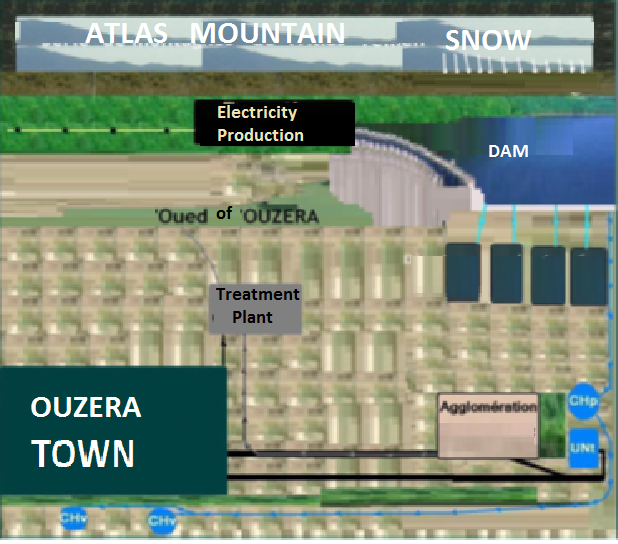
The plan shown in the figure illustrates a model similar to the system of dam with a focus on the water flow system to the smart city and the sewage system for the northern urbanity of Ouzera City
7.scientific effectiveness of the research center on one health as intelligent mind
The scientific effectiveness of the one health research center in Ouzera region depends on its focus on human and animal health , environmental safety and achieving the sustainable development goals , and its centering around the new dam project in Ouzera valley as a study area that takes into account clean living , good health for human and animal , and the goals of life below water.
The one health research center is located within the new urban pole on the eastern side of the smart city of Ouzera .as it integrates with the scientific campus specializing in agriculture and veterinary sciences , as well as with the facility of medical sciences and the specialized university hospital in the smart city of Ouzera.
The establishment of the one health and sustainable center is a strategic scientific step to ensure human an animal health and to study ecosystem for its preservation .
The center is linked to the facilities of scientific and smart city of Ouzera as part of advanced facilities of second and third generation of smart facilities of smart cites which relies on digital data technology integrates artificial intelligence and scientific research , and is centered around the citizen and sustainability and to ensure the effectiveness of research and sustainability of development considering the Ouzera region as smart urban model for studies , analyzing and guiding urban planning with a one health approach.
Four departments are adopted within which the analysis is distributed in the one health research center
-
Department of Ecosystem and life below water
Includes the aquatic ecosystem laboratory and specializes in studying the environmental impacts of the dam on aquatic biodiversity , it also contributes to the management of dam area and the prevention of the leakage of pollutants that affect water quality and life below water.
-
Department of Epidemiology and communicable diseases
Its strategic goal is to achieve good health and well being by studying water related , and vector related diseases around the dam , studying pathogens that may spread in large bodies of water and developing systems for predicting epidemics before the spread , based on changes in the vicinity of the dam, and what the joint epidemiology and environment laboratory provide to implement comprehensive health prevention strategies for the region
-
Department of water quality and sewage system
This department is concerned with the technical and preventive aspects regarding the quality of water and irrigation water to ensure water security for the population and the strategic goal of clean water.
The department also studies sewage systems to protect sewers from urban pollutants.
The department includes laboratory of water quality and bacteriological analysis
-
Department of technology and development
This department includes an advanced laboratory of modeling and development and aims to plan to development and innovation in line with the one health initiative and the smart urban space with healthy and scientific area.
8.Conclusion
Water security and food safety are planned within the one health
Approach integrating roles between the veterinary , medical and environmental management and urban engineering and relying on proactive epidemic control through integrated monitoring systems and risk assessment to prevent the spread of food borne and waterborne diseases.
The strategy for building the Ouzera dam can be effective for the construction of other dams in Algeria
Furthermore, the one health initiative adopted in the planning for the protection and operation of Ouzera dam can be applied to dam projects in general.
Urban planning in Ouzera City achieves urban sustainability through one health and urban metabolism approach.
The integrated approach based on multidisciplinary planning and one health initiative is adopted in the healthy urban space development .While the efficient and sustainable regional space is planned with the one health approach.
An effective approach to building healthy and smart city and new urban poles can be considered one that is integrated in planning and based on biomimetics , biophilic design , the concept of urban metabolism , the one health approach , and the simulation of resilient and vital mobility.
While approaches based on biophilic design and the concept of urban metabolism , resilient mobility simulation and the one health approach are suitable for organizing the urban space of old metropole cities for a health and suitable urban environment
9.Bibliographical readings
English bibliography
1. Abderrahmane.M (2024) ; Observatory of town and biomimetics for urbanmodeling and Architectural design of scientificscpace in landscaped site .Research and Analysis Journal .7(8).71-91
2. Abderrahmane M (2024) ;Towards One health for All ;Maintaininghumanhealth in a townthroughIntegration of an integratedscientificprojectsinto a healthylandscaped site .Research and Analysis Journal 7(10).01-07.
3. Abderrahmane.M. (2024) ; Environmentalhealth and transportation :A landscape design of a vital healthy area in an ecologicaltown.Research and Analysis Journal.7(11).43-46.
4. Abderrahmane.M. (2025) ;Urban landscape design through landmarks and vital design of urban areas integratedwithhealthcare facilities.Research and Analysis Journal .8(2).31-40.
5. Abderrahmane.M. (2025) ;Urban mobility and resilience ; Planning and design a commercial zone and zone of activities for efficient and healthy Town.Research and Analysis Journal 8(5).24-30
6. Abderrahmane M (2025) ; Innovation concepts for urban planning and design ; Scientific and biomimetic design of a scientific and smart city in healthy and landscaped area.Research and Analysis Journal 8(7).25-33.
7. Abderrahmane M (2026) ;Biophilic design of vital urban area and planning of résilient territorial mobility for healthy and smart city. Research and Analysis Journal 9(1).01-12.
8. A.VanTimmeren (2008); waste management in the built environment on the basis of decentralization and integration strategies: The urban metabolism.WIT Transactions on ecology and the environment .Vol 109.pp 51-62.
9. A.M.Helmirch and al (2020); Using biomimecry to support resilient infrastructure design , Earth’s Future .8 .e2020 EF001653..
10. D.Kaluk and K Emine (2022) ;Biophilic architecture and water : Examining water as a spatial senergy element.IDA.Vol 4 ,Issue 2. pp 252-270.
11. F.Geremicca and MM Bilee (2024);Searching for new urban metabolism technologies: review towards future development for a city scale urban metabolism digital twin. Sustainable cities and society .Volume 107:105445
12. H.Chahraoui and al (2021); Analysis of extreme events and estimated of parameters :Case of Mazafran watershed northern Algeria.Arabian Journal Of Geosciences. 14:2093.
13. M Hoyer and J Wangel (2014) ;Smart sustainable cities ; definition and challenges .ICT Innovations for sustainability Advances in intelligent systems and computing .310.
14. N .Boichule and al (2025);Exploring the role of industry 4.0 technologies in smart city evolution : A literature based study.Sustainability.17,7024.
15. S.EL Bar and al (2024) ; Towards resilient cities :Biomimetic strategies for urban adaptation. International Journal of Innovative technologies in social science N°4(44).
16. S .E. Taylor and al (2007); An intervention to reduce the use of error prone prescribing abbreviations in the emergency department .Journal of pharmacy practice and research .Vol37.issue 3. pp214-216. QField Ecosystem Documentation (2026) Technical Reference.
French bibliography
I. Hamadi and al (1976) ; Mission Report in Algeria (October 15.20..1976) Presented to the directorate general of agronomic research. Algiers.
II M C.Bakroune( 2011) ;Dynamic analysis of roller compacted concrete (RCC) dam under seismic load .Master thesis. University of Batna..
*Source of picture :Facebook account allowed to everyone. (From the municipality of Ouzera).
* Old map of Ouzera territory showing the source Of Oued Ouzera
*1. Google Earth.
*2. Geological map of Algeria
*3. Topographical map online
*4 . Hydraulogical map of Médéa online .